
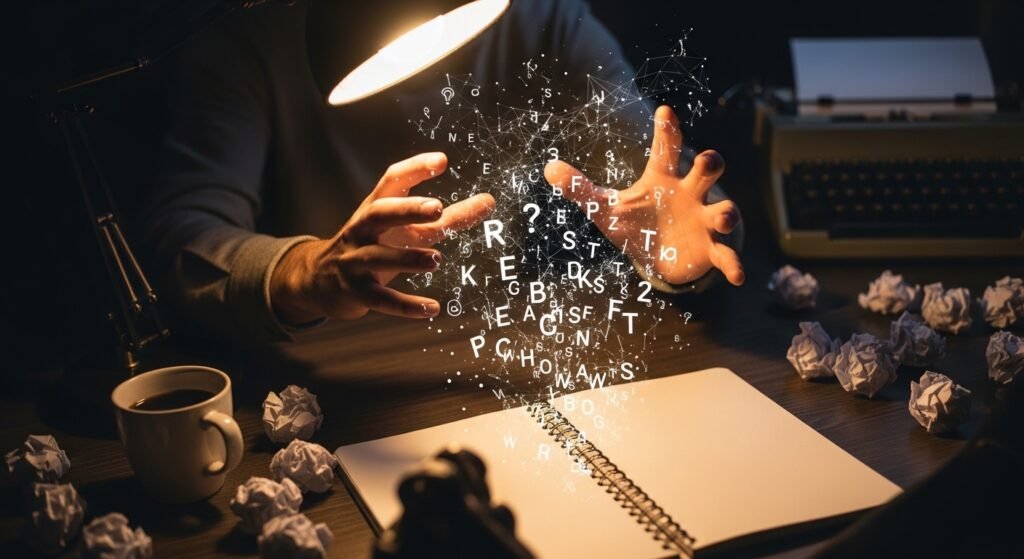
By mid-2026, the market value of perfect prose has reached zero. When an algorithm can generate a flawless, grammatically pristine book in seconds, perfection is no longer a skill. It is a commodity. We have hit the Synthetic Ceiling. This is a point where the more polished a piece of content looks, the less a human reader values it. People are exhausted by smooth, rounded-off sentences that sound like everyone and no one at the same time.
In an era of hyper-inflation of the average word, your complex irregularities are no longer errors. They are the digital watermarks of your humanity. The goal is no longer to be better than a machine. It is to be irreplaceable by one. In the 2026 economy, the market does not pay for information. It pays for the Biological Signature of someone who has actually lived through the consequences of their ideas.
Some believe that using AI to polish every sentence is the way to stay competitive. But that is the quickest path to becoming invisible. If you strip away the jagged edges of your perspective to sound more professional, you are simply blending into the automated background. You are competing on the machines’ home turf, and you will lose. The real strategy is to protect the parts of your narrative that an algorithm would try to fix.
Key Takeaways
- The Synthetic Ceiling: The unlimited supply of automated content has devalued correct writing, making human-led stories more expensive and rare.
- The Luxury of Inefficiency: Irregular glitches and non-linear thoughts are now high-value signals of authenticity that readers scan for.
- The Scarcity of Consequence: Machines can simulate actions, but they cannot experience the fallout of a choice. This weight is your un-copyable asset.
- Digital Forensics: The market is moving from validation to verification. Readers want proof that a story grew in the soil of reality.
- Narrative Monopoly: You build authority not by being the most polished, but by being the most irregular and difficult to simulate.
The Synthetic Ceiling: The Hyper-Inflation of the Average
When Correct Becomes Invisible
We are living through a massive economic shift in how words are valued. For decades, being a good writer meant having perfect grammar and a clear, professional tone. In 2026, those things are the baseline. They have a price of zero because they are built into every device we own. This has created a world of B+ content. It is content that is not bad, but it is not human either. It is the Algorithmic Average.
The algorithm works by predicting the most probable next word. This results in writing that is safe, balanced, and entirely forgettable. When you read a page of synthesized text, your brain does not have to work. There is no resistance. Because there is no resistance, there is no memory. Correctness has become a form of camouflage. If your book is perfectly balanced and avoids all weirdness, it will be treated as noise.
The Readers Allergy to the Glossy Void
Human brains are evolving to detect the lack of a biological signal. We are developing an allergy to the glossy void of automated text. You can see this in how people scan articles or books. They skip past the smooth, introductory paragraphs and look for something jagged. They look for a specific name, a strange detail, or a raw opinion that feels slightly uncomfortable.
The demand for complex narratives is rising because synthesized summaries offer no nutrition. They provide information without context. They give you the map but never the feeling of the dirt under your feet. In a world where everyone has access to the same automated summaries, the person who provides the complex, irregular truth becomes the only one worth listening to.
The Economic Value of Inefficiency
Inefficiency as a Luxury Good
AI is the height of efficiency. It is fast, sterile, and optimized for speed. Human thought is the opposite. It is slow, irregular, and expensive to produce. In the past, we tried to hide our inefficiency. We wanted to look as fast and as perfect as possible. But in 2026, inefficiency has become a luxury good.
Think of the difference between a 3D-printed chair and one carved by hand from a single piece of oak. The 3D-printed chair is more perfect, but the oak chair has a Biological Signature. It has knots in the wood. It has tool marks. It has a history that cannot be programmed. Your story needs those knots. The time it took you to learn a lesson through failure is what gives that lesson its market value.
The Biological Signature
The jagged edges of your experience are the only way to prove you are not a bot. When you write about a specific moment of confusion or a choice that did not make logical sense at the time, you are leaving a biological watermark. You are signaling to the reader that this story grew in soil, not in a lab.
This is the difference between soil-grown insight and hydroponic content. Hydroponic content is grown in a vacuum. It is clean and fast, but it lacks the depth of flavor that comes from fighting the elements. Soil-grown insight is weather-beaten. it is shaped by friction, sun, and rain. The reader can taste the difference. They can feel the weight of a thought that was formed through real-world pressure.
The Strategic Glitch
You must identify the parts of your internal monologue that an algorithm would try to fix. If you have a thought that feels a bit too weird, or a memory that seems irrelevant to the main point, do not delete it. That is the Strategic Glitch. It is the part of the narrative that breaks the pattern.
Algorithms are designed to find and follow patterns. When you break the pattern, you become un-copyable. You create a narrative that a machine cannot predict. This irregularity is what anchors the reader to your voice. It is the reason they will remember your name and forget the ten other articles they read that morning.
The Scarcity of Consequence
Machines Cannot Suffer
There is a massive philosophical barrier that AI will never cross: the ability to suffer consequences. An AI can simulate a story about losing a business. It can use the words “pain,” “loss,” and “regret.” But it never felt the hunger. It never had to tell its family that the money was gone. It never felt the physical weight of a bad decision in the pit of its stomach.
Because a machine cannot suffer, its narrative has no weight. It is an imitation of a feeling, not the feeling itself. When you write about the fallout of your choices, you are using an asset that is in extreme scarcity. You are sharing the weight of having something to lose. This is why we still listen to the survivor of a crisis over a person who just researched the crisis. The survivor has skin in the game.
Skin in the Game as Intellectual Property
Your history of risk is your most valuable intellectual property. The market values a flawed survivor over a perfect observer every time. When you weaponize the parts of your journey where you had everything to lose, you are building a wall around your brand.
A competitor can copy your advice. They can copy your framework. But they cannot copy the weight of your history. They cannot simulate the exact way you felt when you were standing on the edge of a major transition. By leaning into the parts of your life that carried the most consequence, you are creating a narrative monopoly. You are offering a perspective that cannot be mass-produced.
Narrative Forensics: Verifying the Human Signal
From Validation to Verification
The old way of building authority was through validation. You sought degrees, awards, or titles to prove you were worth listening to. In 2026, the focus has shifted to verification. The question is no longer “Are you an expert?” but “Are you real?” In an era of deepfakes and hallucinations, people are performing narrative forensics on everything they consume.
A book serves as a Biological Proof of Humanity. It is a long-form signal that requires a consistent human mind to sustain. While an AI can produce a convincing page, it struggles to maintain the complex, self-referential threads of a human life over three hundred pages. A book is your encrypted signature. It is the evidence that a biological entity was present and active.
The Monopoly of Experience
Data is a commodity. Perspective is a currency. Information is everywhere, but the way you interpret that information is unique to your history. You must move from providing “what” to providing “how it felt.”
Expert Tip: Your weirdest thoughts are your strongest barrier to entry. The parts of your story that feel the most difficult to explain are often the ones that provide the most value. They are the parts that a machine would round off into a general statement. By protecting those specific, irregular thoughts, you are ensuring that your work remains a monopoly. You are giving the reader a lens that they can’t get anywhere else.
The Choice: Synthetic Safety or Narrative Monopoly
Avoiding the Commodity Trap
There is a massive risk in sounding professional. When you try to sound professional, you are usually trying to sound like a specific standard. That standard is exactly what AI has mastered. If you follow the rules of a “perfect” book, you are putting yourself in the commodity trap. You are making yourself replaceable.
The 2026 economy punishes the average. It ignores the smooth and the balanced. But it rewards the irregular. It rewards the author who is willing to be awkward, specific, and deeply human. You have a choice: you can choose the synthetic safety of looking like a bot, or you can choose the narrative monopoly of looking like yourself.
The Insurance Policy of the Printed Word
A book is no longer just a way to share a story. It is an insurance policy against being automated out of your own industry. As AI takes over more of the technical and informational tasks of our world, the only thing that remains safe is the personal narrative. You cannot automate a person’s life story. You cannot automate the way someone’s eyes see a sunset or a boardroom.
By committing your perspective to a book, you are claiming your ground. You are saying that this space belongs to a human being. You are issuing a currency that is backed by the one thing the machine doesn’t have: a biological life.
Issuing Your Own Currency
Writing a book is the act of turning your life into a currency. Every page is a note of value that proves you were there, you felt the weight, and you learned the lesson. In a world where words are becoming cheap and unlimited, your specific, jagged narrative is the only thing that will hold its value over time.
Do not try to be perfect. Do not try to be smooth. The world has enough of that. The market is starving for the jagged edges. It is looking for the “weird” parts that an algorithm would delete. When you find those parts and put them on the page, you aren’t just writing; you are verifying your existence. You are building a monopoly that no machine can ever touch.
The Role of Sense Wide Lens
At Sense Wide Lens, we do not exist to clean your story. We do not want to polish away the parts that make you human. Our role is the opposite. We act as protectors of the Human Signal. We look at your raw material and help you identify the Strategic Irregularities that make your story un-copyable.
We understand that in 2026, the value of a book is in its Biological Signature. We help you navigate the forensics of your own experience to find the parts that a machine could never invent. We don’t just help you structure a book; we help you issue a narrative currency that cannot be devalued by the hyper-inflation of the automated word.
We believe that your flaws are the most interesting part of your authority. We work with you to ensure that those flaws are presented with clarity and impact, but we never remove them. Our process is about building a partnership that respects the grit of your reality. We help you find the un-copyable parts of your story and turn them into a manuscript that stands as a proof of humanity.
Stop trying to be perfect and start being verifiable. Your story is the only asset that the machine cannot replicate. Let’s find the jagged edges together.
Check out our services to find out how to weaponize your unique perspective and claim your narrative monopoly.
Frequently Asked Questions
Are stories really more valuable than skills in 2026?
Skills are becoming commodities. If a skill can be described in a manual, it can be performed by an algorithm. Stories represent the application of those skills in the chaotic, physical world. They show the judgment, the failure, and the recovery that a machine cannot simulate. That human context is where the real value lives today.
Why does generic content feel empty now?
Because it lacks the weight of consequence. We can subconsciously detect when a sentence has been generated based on probability rather than experience. It feels like a “glossy void” because there is no human mind on the other side of the words. Our brains are designed to look for friction, and when we don’t find it, we stop paying attention.
Can AI replace human storytelling?
AI can imitate the structure of a story, but it cannot create the “soil-grown” insight of a lived life. It is a mirror, not a source. It can only rearrange the stories we have already told. The spark of a new, authentic perspective is a purely biological achievement that requires a physical presence in the world.
How do I stand out when everyone is using AI tools?
By protecting your “weird” thoughts. The ideas that feel a bit too strange or specific are the ones the AI would try to fix. Those are your un-copyable assets. Lean into your specific failures, your strange observations, and your non-linear logic. The more you sound like a specific person, the more you stand out from the algorithmic average.
Why are human flaws becoming a strategic advantage?
Because flaws are a signal of reality. AI is programmed to be perfect and safe. Therefore, perfection has become a sign of a machine. Human flaws, specific mistakes, and jagged narratives are the only way to verify that a human mind was at work. In a world of deepfakes, the “unpolished” truth is the only thing people can trust.
What is the Narrative Premium?
This is the extra value the market is willing to pay for content that has a verified human source. As the supply of automated content goes up, its value goes down. This creates a premium for the “Human Signal.” People will pay more for a book that they know was written through real friction and experience.
How does a book act as an insurance policy?
A book is a permanent, long-form proof of your intellectual property. It is your “Proof of Humanity.” By committing your thoughts to a physical, bound object, you are anchoring your authority in a way that digital content cannot match. It is a way to verify your expertise before the digital world becomes entirely dominated by automated noise.
About the Author:
Ankit Sharma is a dedicated storyteller and editorial strategist who understands the deep emotional shift from writing a draft to holding a finished book. Through his work, he has guided many authors through the difficult transition from digital files to physical manuscripts that represent a lasting family legacy. Ankit specializes in helping writers visualize their end goals to overcome the psychological hurdles of the drafting process. His expertise lies in grounding abstract ideas into tangible results, guaranteeing that every author he supports feels the quiet pride of seeing their name in print. By focusing on sensory details and structural integrity, he transforms the solitary act of writing into a shared achievement of professional authorship.
Ankit recommends this article, which talks about finding courage to tell your story.
Disclaimer: All information provided in this article reflects our personal research and professional views on the narrative economy. Every author’s journey is unique, and individual results in the publishing market may vary based on effort and specific context. If you have questions about how to protect your human signal in your next project, please reach out to us for a tailored conversation.